
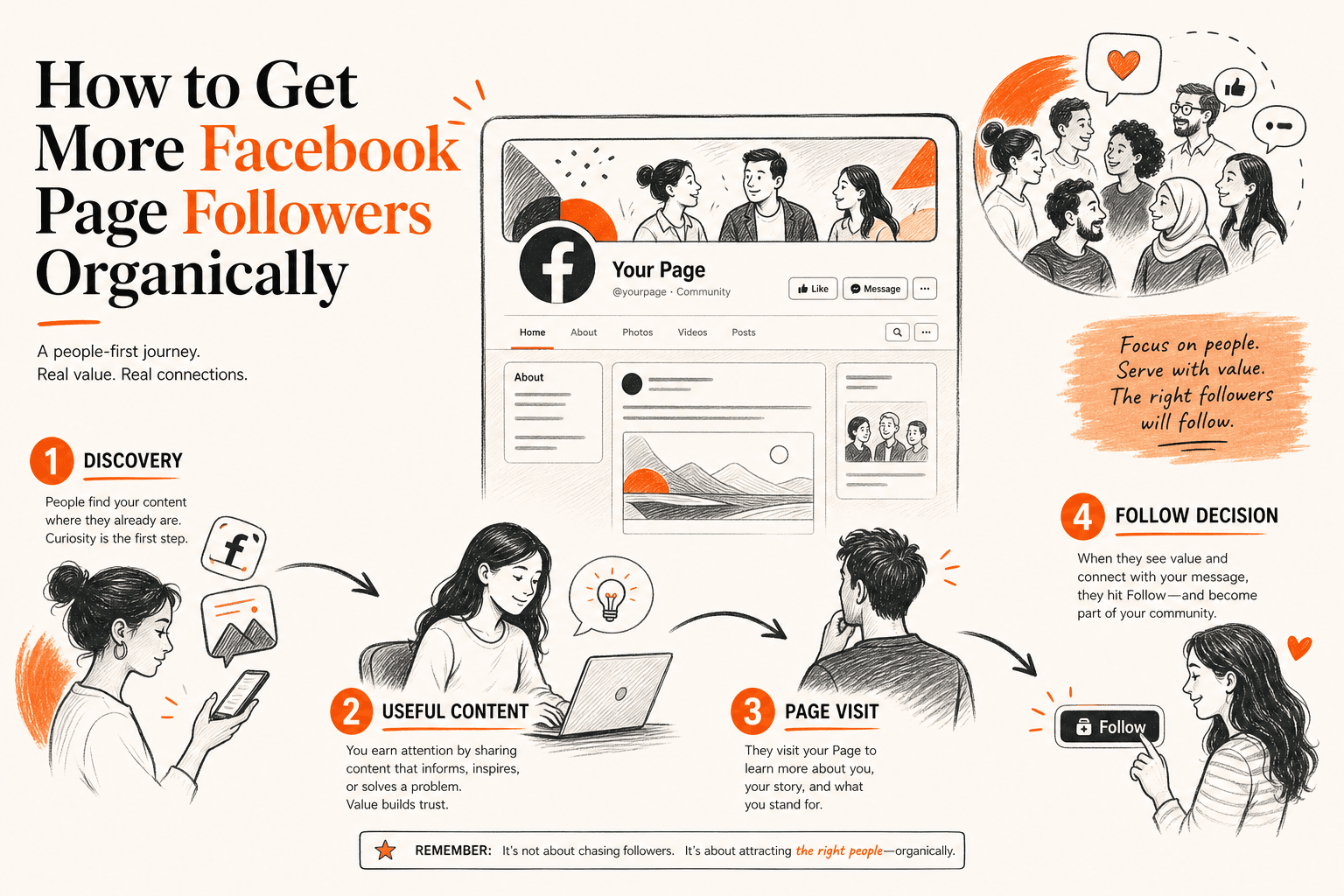
Getting more Facebook Page followers is not simply a matter of posting more often.
People follow Pages because they expect something from them.
That might be:
- useful information,
- local updates,
- entertainment,
- product news,
- industry expertise,
- offers,
- community content,
- or content they want to see again.
Facebook defines following a Page as a connection where the person may receive updates from that Page in Feed. (Facebook)
So if you want more followers organically, the useful question is not:
“How do I make the follower number increase?”
It is:
“Why would someone who discovers this Page choose to keep seeing it?”
That shift changes the strategy.
Instead of chasing follower-count tricks, focus on:
- Discovery
- Useful content
- Profile/Page evaluation
- Follow decision
- Continued value
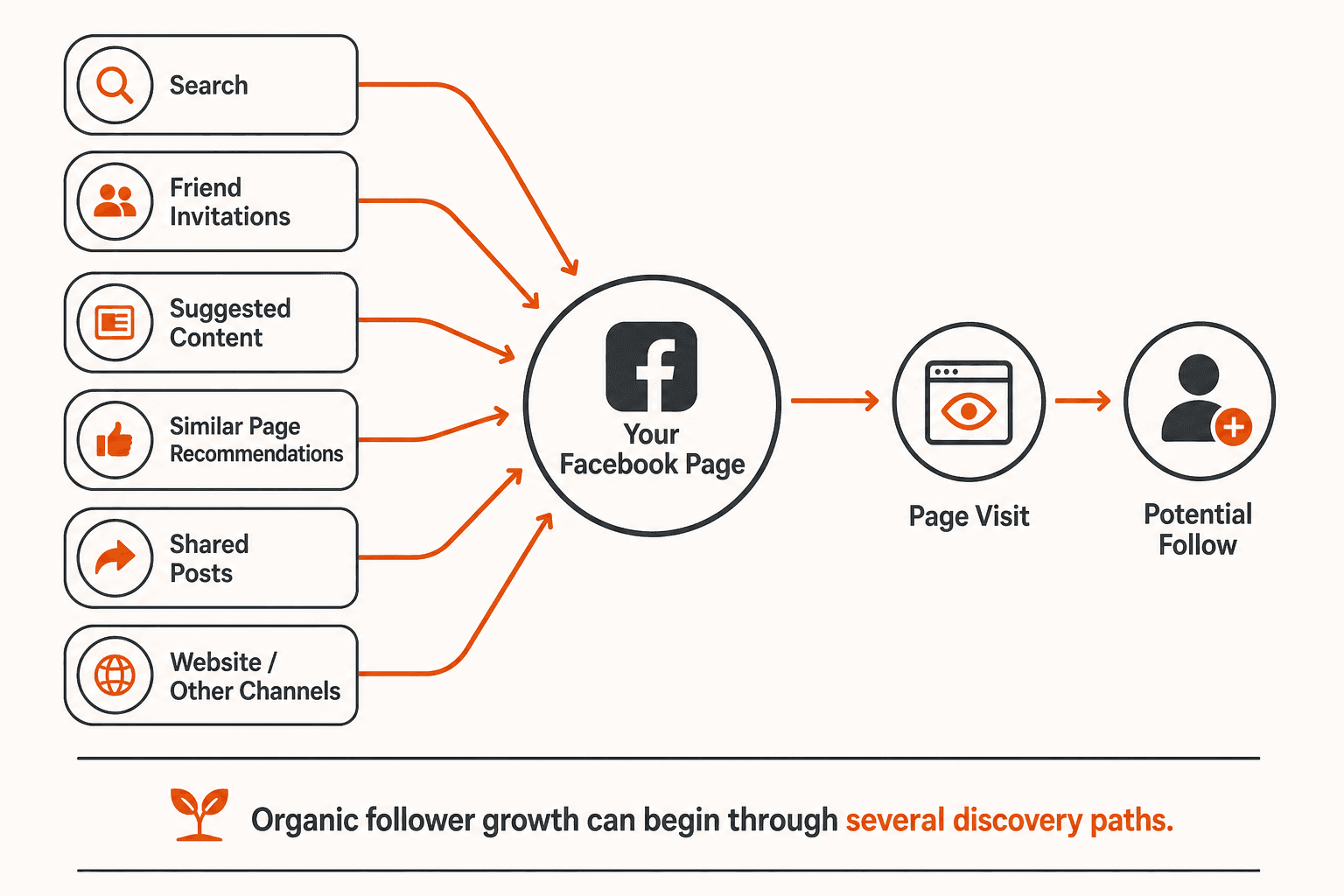
Facebook also has recommendation systems that can surface suggested posts and Pages to people who do not already follow them, so your existing follower base is not the only possible source of discovery. (Facebook)
There is no guaranteed organic-growth formula.
But you can make your Page easier to discover, understand and follow.
At a glance
- Make the Page purpose obvious
- Publish content your intended audience actually wants
- Use Facebook's invitation features appropriately
- Create content that can reach beyond existing followers
- Review Page Insights instead of guessing
- Repeat topics and formats that attract the right audience
- Make following the Page a logical next step
1. Make It Immediately Clear Why Someone Should Follow Your Page
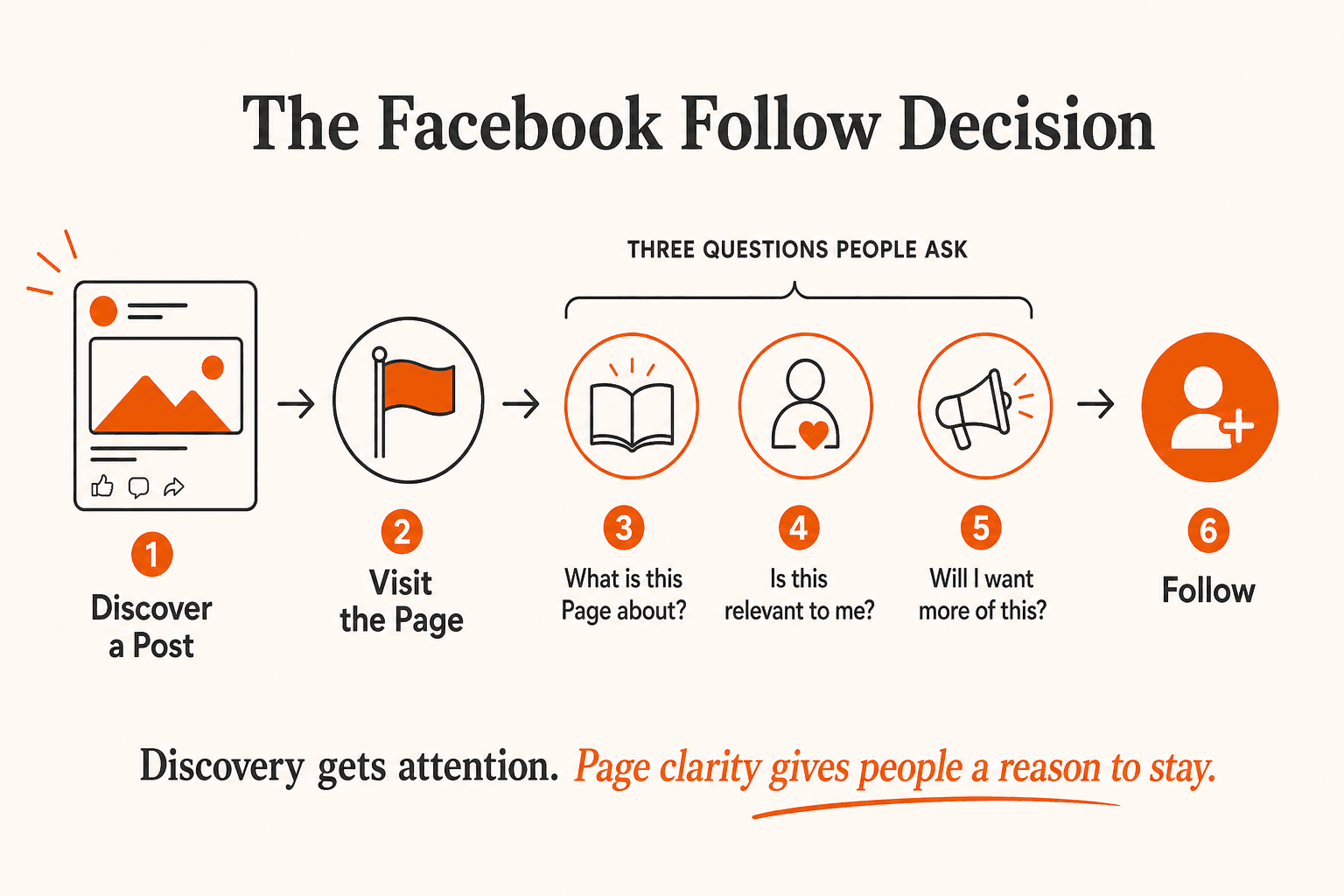
Imagine somebody discovers one of your Facebook posts.
They like it enough to click the Page name.
They arrive on your Page.
Now what?
Within a few seconds, they should be able to understand:
- Who is this Page for?
- What does it publish?
- Why should I follow it?
A Page that looks like:
- a random sales post,
- an unrelated meme,
- a company announcement,
- a three-month-old photo,
- then another sales post
does not create a particularly clear expectation.
Compare that with a local roofing company whose recent posts consistently cover:
- storm-damage advice,
- roof maintenance,
- before-and-after repairs,
- common roofing problems,
- local weather preparation,
- and project examples.
A visitor can quickly understand what following that Page might provide.
Think Beyond the Business Description
Your Page description explains what the business is.
Your content shows what the Page is for.
Those are not necessarily the same thing.
A plumber might be “a licensed plumbing company serving Melbourne.”
But the Facebook Page could offer practical home plumbing advice, project updates and local service information.
That second idea gives the follower a reason to return.
2. Create Content for a Specific Audience
Trying to appeal to everyone often makes a Page less distinctive.
Consider a real estate Page.
It could post:
- generic motivational quotes,
- random celebrity news,
- holiday greetings,
- unrelated memes,
- and occasional property listings.
Or it could build content specifically for first-time home buyers in a particular city.
That creates much clearer ideas:
- What to check during a house viewing
- How deposits work
- Questions to ask an agent
- Common first-buyer mistakes
- Area comparisons
- Property terminology explained
- New listings
- Local market observations
The second Page gives a defined audience more reasons to follow.
Ask Who Exactly Should Care About This Page
The useful question is not “Who exists on Facebook?”
The more clearly you understand the audience, the easier it becomes to decide what belongs on the Page.
3. Give People a Reason to Follow Beyond One Post
A single good Facebook post can attract attention.
But the follow decision is about the future.
Someone may think “That post was useful” without thinking “I want updates from this Page.”
Your content library should help bridge that gap.
Suppose you publish “5 Signs Your Air Conditioner Needs Repair.”
A visitor clicks your HVAC Page.
The next posts include:
- Why AC units freeze
- How often filters should be changed
- Repair versus replacement
- How to reduce summer cooling problems
- A recent repair example
Now the visitor sees a pattern.
They aren't following for one answer.
They're following because the Page repeatedly addresses something they care about.
4. Use Facebook's Invite Feature Appropriately
Facebook has an official feature that lets people invite friends to follow a Page or profile. Its current Help Center provides an Invite friends workflow directly from the Page/profile interface. (Facebook)
That makes invitations a legitimate Facebook-native way to introduce an existing personal network to a Page.
But use it sensibly.
Do not interpret the existence of an Invite button as permission to invite every person to every Page regardless of relevance.
If you run a local auto repair shop in Toronto, inviting people who actually know you, live nearby or may care about the business makes more sense than treating every Facebook friendship as a lead.
Better Approach
Invite people who have a plausible reason to care about the Page.
That might include:
- existing professional contacts,
- local friends,
- past customers where appropriate,
- people involved in the business,
- or relevant personal connections.
The goal is to introduce the Page.
Not to spam everyone you have ever added.
Can You Invite People to Follow a Facebook Page?
Yes. Facebook's current Help Center includes a Page/profile feature for selecting friends and sending invitations to follow. (Facebook)
That makes this one of the simplest organic starting points for a new Page.
But invitations are only the beginning.
Once somebody arrives, your Page still needs content worth following.
5. Make Sure Your Page Can Appear in Similar Page Suggestions
Facebook currently provides a setting allowing Page managers to permit their Page to be recommended to people looking at similar Pages. (Facebook)
This is worth checking.
Facebook's wider recommendation system includes discovery experiences such as Pages you may like and suggested Feed content. (Facebook)
That means organic Page discovery does not need to come only from:
- existing followers,
- direct searches,
- or links from your website.
Facebook can also introduce people to Pages through recommendations.
Practical Check
Review the Page's recommendation/suggestion settings and make sure you have not accidentally disabled an opportunity for Facebook to recommend the Page alongside similar Pages.
Do not interpret this as a ranking guarantee.
Enabling recommendations means the Page may be suggested where relevant.
It does not guarantee a particular number of followers.
6. Publish Posts Worth Sharing
A useful Facebook post does not need to be complicated.
Sometimes the best content answers something your audience already asks.
For a dentist:
- What causes bleeding gums?
- When should a child first visit the dentist?
- Whitening versus cleaning
- What to do with a chipped tooth
For a restaurant:
- New menu item
- Behind-the-scenes preparation
- Chef explanation
- Local event
- Customer question
For an accountant:
- Tax deadlines
- Common bookkeeping errors
- Expense explanations
- Small-business financial reminders
The important part is usefulness or relevance.
If people find a post useful enough to share, it can introduce the Page to people outside the immediate follower base.
Facebook's recommendation system can also suggest content from Pages users do not already follow. (Facebook)
7. Stop Making Every Post an Advertisement
Businesses often create a Facebook Page and then publish:
- BUY NOW
- CALL US
- 20% OFF
- BOOK TODAY
- GET A QUOTE
again and again.
Those posts can have a place.
But ask:
Why would someone follow a Page whose only function is repeatedly asking them to buy?
A stronger content mix might include:
- education,
- examples,
- answers,
- stories,
- local information,
- customer questions,
- product demonstrations,
- then commercial posts where appropriate.
The Page still supports the business.
It just gives the audience more reasons to stay connected between purchases.
8. Turn Customer Questions Into Facebook Content
Your business already has a content research source: your customers.
Collect questions from:
- phone calls,
- emails,
- WhatsApp,
- comments,
- sales conversations,
- contact forms,
- support conversations,
- and in-person discussions.
If several customers ask “How long does this take?” that can become a post.
If people ask “What’s the difference between X and Y?” make a comparison.
If people repeatedly misunderstand a service, explain it.
This works because you're creating content around proven audience questions instead of inventing topics just to maintain a posting schedule.
9. Use Multiple Facebook Content Formats
You do not need to use every Facebook format.
But you also do not need to publish only static promotional graphics.
Depending on what genuinely suits the Page, test:
- text posts,
- photos,
- videos,
- Reels,
- links,
- question posts,
- behind-the-scenes content,
- before-and-after examples,
- and longer explanations.
Then review your own performance.
Facebook provides Page post Insights including metrics such as post reach and engagement, allowing Page managers to evaluate how individual posts perform. (Facebook)
The useful question is:
Which formats work for my audience?
Not:
“Which format does every Facebook Page in the world have to use?”
10. Use Page Insights to Find What Actually Works
This is one of the biggest differences between strategy and guessing.
Facebook Page Insights provides information about Page performance, audience demographics and how people respond to posts. (Facebook)
Facebook also provides follower-specific Insights through the Professional Dashboard, and separate demographic information about people following a Page. (Facebook)
Use that data.
Questions to Ask Every Month
- Which posts received more reach?
- Which posts generated stronger engagement?
- Which subjects performed repeatedly?
- When did follower growth improve?
- What does the follower audience look like?
- Did an unusual post attract people outside the Page's normal audience?
- Which content deserves a follow-up?
Meta specifically describes Page Insights as a way to understand Page performance and how people respond to posts. (Facebook)
11. Repeat Successful Topics Without Copying Yourself
Suppose you publish “5 Mistakes First-Time Home Buyers Make” and it performs well.
The wrong response is to publish the exact same post fifteen times.
The useful response is to investigate the broader subject.
You might follow with:
- Questions to Ask During a Home Viewing
- Common Deposit Mistakes
- How to Compare Two Properties
- Home Inspection Basics
- Costs Buyers Forget to Budget For
You're building a topic cluster for Facebook content.
This gives people who enjoyed one post more reasons to explore and follow the Page.
12. Build Recognizable Content Series
Recurring formats can help a Page develop a recognizable identity.
Examples:
- Monday Marketing Tip
- Roof Problem of the Week
- Before & After Friday
- Question From a Customer
- One-Minute Legal Explanation
- Restaurant Dish of the Week
You do not need catchy names for everything.
The useful part is continuity.
Someone who likes one installment can understand that similar useful content may appear again.
That helps create a reason to follow.
13. Make the Follow CTA Natural
There is nothing wrong with occasionally telling people they can follow the Page.
But the CTA should match the content.
Instead of “FOLLOW US RIGHT NOW,” try something relevant.
For example:
We share practical Facebook marketing guides like this regularly. Follow the Page if you want the next one.
Or:
We publish local property updates each week. Follow the Page to see future reports.
The difference is important.
You are telling the person why following may be useful.
Not merely asking for a number.
14. Use Your Website to Promote the Facebook Page
If a business already gets visitors through Google, SEO, direct traffic, email or referrals, the website can introduce those people to its social channels.
Good places can include:
- footer,
- contact page,
- About page,
- blog,
- or confirmation/thank-you experiences where appropriate.
Do not overwhelm every website page with huge social CTAs.
A simple legitimate link can be enough.
The objective is to make the Page discoverable by people who already know the business.
15. Cross-Promote Without Copying Everything Everywhere
If you also use Instagram, email, a website or another owned channel, you can occasionally tell that audience about useful Facebook-specific content.
But avoid giving people no reason to use both channels.
If every Instagram post, Facebook post and email is identical, people may not see much value in following all of them.
Instead, Facebook might emphasize:
- community discussion,
- local updates,
- longer explanations,
- or Page-specific video content.
Different channels can support the same brand while serving slightly different habits.
16. Respond to Relevant Comments
Organic follower growth is not only about publishing.
Pages also create relationships through interaction.
When people ask genuine questions, respond.
When a comment reveals a useful topic, consider turning the answer into another post.
When someone needs support, help where appropriate.
This creates a Page that looks maintained rather than abandoned.
It also gives you continuous audience research.
But avoid fake engagement tactics such as posting meaningless replies solely to inflate comment totals.
The conversation should have a purpose.
17. Keep the Page Active Enough to Be Useful
There is no universal posting frequency that guarantees Facebook follower growth.
Do not invent one.
A Page does not automatically need:
- three posts every day,
- seven Reels per week,
- or exactly 30 posts each month.
The useful question is:
Can we consistently publish content worth seeing?
One strong post can be more useful than several filler posts.
Use Insights to compare your own publishing patterns and content performance. Facebook specifically provides Page and post-level Insights for this purpose. (Facebook)
18. Make Your Page Look Current
Imagine discovering a business Page whose last post is from 2023.
You may wonder whether the business still operates.
Keeping the Page reasonably current gives visitors more confidence that following it could produce future updates.
That does not mean publishing meaningless content just to change the date.
If there is something useful to communicate, publish it.
If the Page is important to your customer journey, maintain it like an active business asset.
19. Use Audience Data, Not Assumptions
Facebook provides follower demographic data to Page managers through Page Insights. (Facebook)
That can help you understand whether the audience you are building actually resembles the people you intended to reach.
Suppose your business serves homeowners in one region.
But your highest-reaching content consistently attracts an unrelated international meme audience.
The view and follower numbers might look impressive.
But they may not support the Page's actual purpose.
Organic follower growth should ideally improve both quantity and audience relevance.
20. Understand Reach Before Judging Follower Growth
Follower count and post reach are not the same metric.
Our earlier guide on how Facebook Page reach works explains this in detail.
A person may see a Page's content without following it because Facebook can recommend suggested content from Pages the person does not currently follow. (Facebook)
That creates an important opportunity: reach can become discovery.
But discovery alone does not become a follow automatically.
The Page and content still need to create a reason to stay.
Organic Growth vs Facebook Follower Services
Organic audience building and a follower-count service are different things.
Organic growth focuses on:
- content,
- discovery,
- audience fit,
- interaction,
- and continued publishing.
A Facebook follower service concerns the Page's follower-count metric.
If you want to compare that separate option, Facebook followers should be understood as a follower-count service.
It should not be represented as a replacement for organic content strategy or as a guaranteed method for increasing:
- organic reach,
- post likes,
- comments,
- Feed ranking,
- website traffic,
- leads,
- or sales.
Should You Invite Everyone Who Likes a Facebook Post?
Facebook has official invitation features for following Pages, but a useful organic strategy should still consider relevance rather than treating every interaction as permission to spam someone. Facebook's current documented invitation workflow is focused on inviting friends to follow a Page/profile. (Facebook)
If Facebook exposes additional invitation functionality in the interface you use, follow the current platform controls rather than relying on an outdated tutorial.
Facebook changes Page interfaces frequently.
The safe principle is:
Use current native Facebook features as they are actually presented to you.
Should You Join Facebook Groups as a Page?
Facebook allows Pages to request to join groups in situations where the group allows Page participation. (Facebook)
But joining groups purely to drop Page links everywhere is a poor strategy.
If Page participation is allowed and genuinely relevant:
- answer questions,
- contribute useful information,
- respect group rules,
- and avoid turning every discussion into self-promotion.
A useful contribution may introduce people to the Page naturally.
Spam usually introduces them to the Block button.
Do Facebook Reels Help Gain Page Followers?
Reels can be one discovery format worth testing, but there is no guarantee that publishing a Reel automatically creates followers.
Facebook provides Reel Insights so creators can inspect performance rather than assuming every Reel behaves the same way. (Facebook)
The better approach is:
- publish a Reel when the format suits the idea,
- then review reach, viewer response and follower movement where available.
Do not make “Reels always get more followers” a universal rule.
Do More Facebook Posts Mean More Followers?
Not automatically.
More posts create more pieces of content.
They do not guarantee more useful content.
If increasing quantity causes quality and relevance to decline, the extra volume may not help the audience.
Instead of targeting an arbitrary number of posts, ask:
- What questions can we answer this week?
- What useful example can we show?
- What does our audience need to know?
- What performed well enough to deserve a follow-up?
Then publish around those answers.
Do Facebook Giveaways Increase Followers?
Giveaways can attract attention, but they can also attract people primarily interested in the prize rather than the Page itself.
If the prize has little connection to the business, the resulting audience may not remain interested afterward.
For example, a local dentist giving away a generic expensive smartphone could attract a much broader prize-seeking audience than a campaign closely related to its actual services or community.
Any promotion also needs to follow Facebook's current promotional rules, so verify the live platform requirements before launching one.
For follower strategy, the bigger question remains: will the people attracted by this campaign care about the Page after it ends?
Do Viral Posts Create Long-Term Facebook Followers?
They can create discovery.
They do not guarantee long-term audience retention.
Suppose a local construction Page publishes an unrelated funny video that receives enormous reach.
Some people may follow.
Then the Page returns to:
- renovation projects,
- construction advice,
- and local services.
People who followed only for humor may leave.
The stronger outcome is not necessarily the largest possible audience.
It is an audience that has a reason to care about future content.
Should You Follow Other Pages to Get Follow-Backs?
Avoid building strategy around follow-for-follow behaviour.
The purpose of a business Page should be attracting people interested in what the Page actually provides.
A follower gained only because you followed them first may have no genuine interest in your content, your services, your location or your business.
That may increase a visible number without improving the quality of the audience.
Build the Page around relevance instead.
Can Facebook Recommend Your Page to New People?
Yes. Facebook has recommendation experiences including Pages you may like, and it has a Page setting allowing a Page to be recommended to people viewing similar Pages. (Facebook)
Facebook can also suggest content from Pages people do not currently follow. (Facebook)
This means new follower acquisition can happen through Facebook discovery itself.
But there is no guarantee that turning on recommendations will produce a particular number of new followers.
It is an opportunity for discovery, not a growth promise.
Does More Engagement Guarantee More Followers?
No.
Someone can:
- like a post,
- comment,
- share,
- or watch
without following the Page.
A follow is an additional decision.
This is similar to the distinction we covered in Facebook Followers vs Page Likes vs Post Likes.
Each metric represents something different.
The practical objective is to make people who enjoy your content understand why following the Page could be useful.
How Long Does Organic Facebook Page Growth Take?
There is no universal timeframe.
A brand with existing customers, website traffic, an email list, strong local recognition and regular content starts from a different position than a completely unknown Page launched yesterday.
Likewise, audience size and content demand differ enormously between industries.
Avoid guarantees such as “1,000 followers in 30 days organically” unless you are simply describing an actual historical case with evidence.
For planning, focus on repeatable activity rather than a promised deadline.
What Should a New Facebook Page Do First?
If you're starting from zero, use a simple sequence.
Step 1: Complete the Page
Make the identity and purpose clear.
Step 2: Publish Several Useful Pieces of Content
Give visitors something to evaluate before aggressively promoting the Page.
Step 3: Invite Relevant Friends
Facebook provides a native friend-invitation workflow for Pages/profiles. (Facebook)
Step 4: Check Similar-Page Recommendations
Review whether the Page is allowed to appear as a recommendation alongside similar Pages. (Facebook)
Step 5: Connect Existing Channels
Add legitimate links from your website or other owned channels.
Step 6: Keep Publishing
Answer real audience questions and develop useful recurring topics.
Step 7: Review Insights
Facebook Page Insights can show Page performance, audience information and post response data. (Facebook)
Step 8: Create More of What Works
Use evidence from several posts rather than guessing from one result.
A Simple 30-Day Organic Facebook Follower Plan
This is a planning framework, not a promise of follower numbers.
Week 1: Foundation
- Clarify Page positioning.
- Update Page information.
- Publish 3–4 useful posts so visitors have something worth exploring.
- Check recommendation settings.
- Invite a relevant first group of contacts.
Week 2: Audience Questions
- Publish answers to several real customer questions.
- Test one visual or short-video format.
- Respond to genuine comments.
Week 3: Build a Series
- Take the topic that generated the best audience response.
- Create 2–3 distinct follow-up posts around it.
- Add a natural follow CTA to one of them.
Week 4: Review
Use Page Insights to compare reach and engagement on your posts. Facebook exposes post reach and engagement data through Page Insights. (Facebook)
Ask:
- Which topics reached more relevant people?
- Which content produced meaningful interaction?
- Did follower growth change?
- Which posts deserve another related piece?
Then create next month's plan from what you learned.
What Not to Do for Facebook Follower Growth
Avoid treating these as your strategy:
- Buying fake personal accounts
- Spamming links in unrelated groups
- Inviting completely irrelevant people at scale
- Publishing copied viral posts unrelated to the business
- Follow-for-follow schemes
- Posting meaningless content only to increase frequency
- Promising giveaways you cannot fulfill
- Assuming every follower will see every post
- Believing follower count guarantees sales
The target should not simply be “make number bigger.”
It should be: build a Page people can discover, understand and reasonably want to continue following.
How to Measure Organic Facebook Follower Growth
Do not judge performance only by a single current follower total.
Record trends.
For example:
- Beginning of month follower total
- End of month follower change
- Posts published
- High-performing topics
- Reach patterns
- Engagement patterns
Facebook provides follower Insights through the Professional Dashboard and Page performance data through Page Insights. (Facebook)
Then ask: what changed when follower growth changed?
That question produces useful insight.
Follower Quality Matters More Than Random Volume
Imagine two Pages.
Page A
- 10,000 followers
- Most have little relationship with the Page's niche or location.
Page B
3,000 followers
Many are:
- local customers,
- potential customers,
- industry participants,
- or people genuinely interested in the topic.
Which audience is more valuable?
There is no universal calculation.
But for a business, relevance generally matters because the goal usually extends beyond displaying a follower number.
That is why organic strategy should focus on attracting people who have a reason to care about future content.
Organic Facebook Growth Is a System, Not a Trick
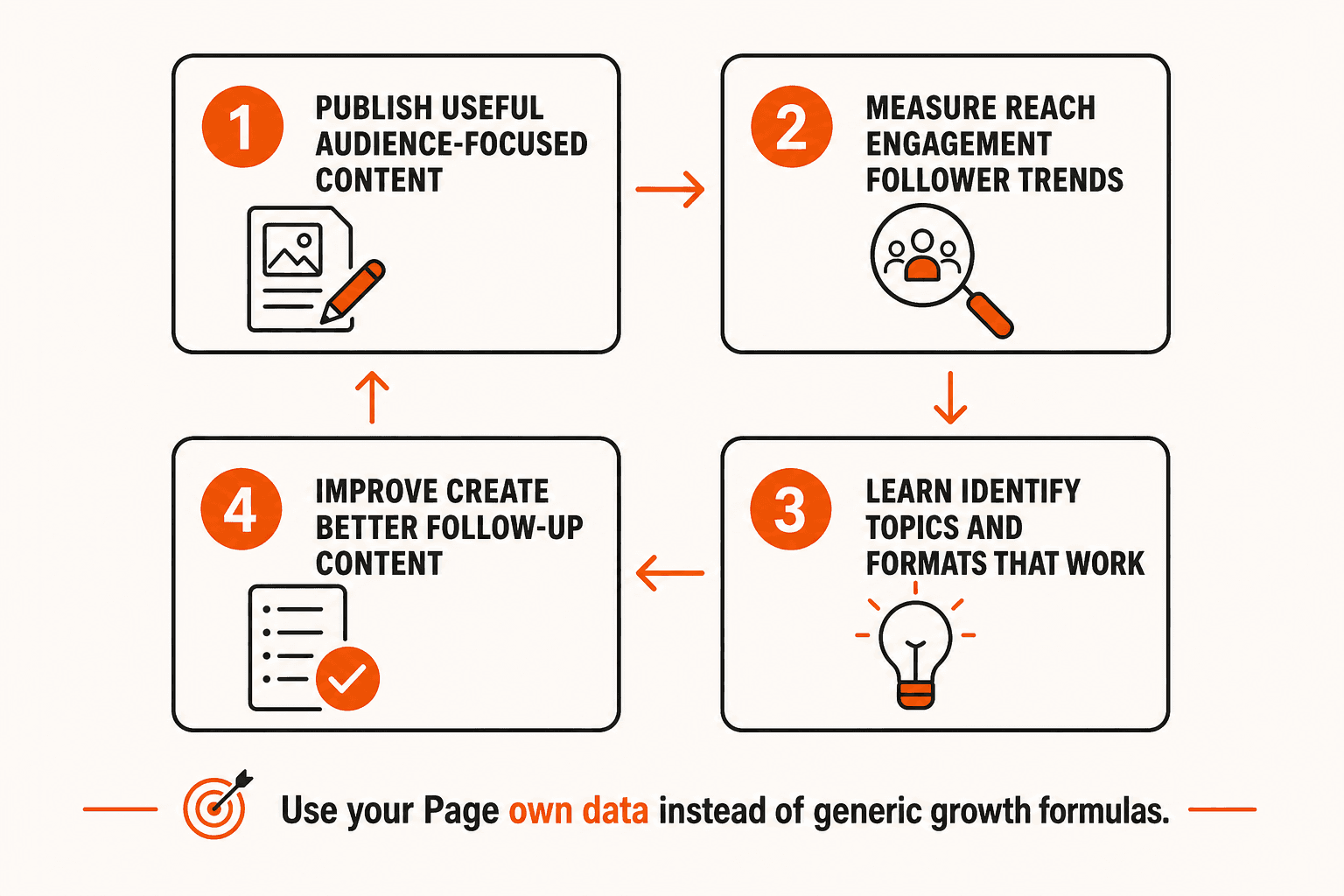
The strongest way to think about Facebook Page follower growth is as a loop:
- Create something relevant
- Facebook/users help it get discovered
- Someone visits the Page
- The Page makes its purpose clear
- Some visitors choose to follow
- You learn from Page Insights
- You publish better content
Then repeat.
Facebook gives Pages native tools for invitations, recommendations and Insights, while its broader recommendation systems can introduce users to Pages and content they do not already follow. (Facebook)
There is no need to invent a secret follower-growth algorithm.
Build a Page worth following.
Make it discoverable.
Study what your actual audience responds to.
Then do more of the useful parts.
Key Takeaways
- Following a Facebook Page creates a connection through which people may receive Page updates in Feed.
- Facebook has an official feature for inviting friends to follow a Page or profile.
- Pages can allow Facebook to recommend them to people viewing similar Pages.
- Facebook can suggest posts and Pages to people who do not already follow them.
- Page Insights provides Page-performance, audience and post-response data that can guide future content decisions.
- Post Insights can include reach and engagement information.
- More followers do not automatically guarantee more reach, engagement, traffic, leads or sales.
- Organic follower growth works best when discovery is followed by a clear reason to continue following the Page.
Frequently asked questions
How can I get more followers on my Facebook Page for free?
Start with clear Page positioning, useful audience-focused content, Facebook's native friend-invitation feature, recommendation settings and your existing website/customer channels. Then use Page Insights to understand which content performs best.
Can I invite friends to follow my Facebook Page?
Yes. Facebook provides an Invite friends feature that lets users select friends and send Page/profile follow invitations.
Can Facebook recommend my Page to people who don't follow it?
Yes. Facebook recommendation experiences include Pages you may like, and Pages can allow themselves to be recommended to people looking at similar Pages.
Does posting every day guarantee more Facebook followers?
No. Facebook does not provide a rule guaranteeing follower growth from a particular posting frequency. Use your own Page Insights to compare content performance and audience response.
Can people see Facebook posts from Pages they don't follow?
Yes. Facebook says suggested content may include posts from Pages and groups a person does not already follow.
How can I see which Facebook posts perform best?
Page Insights provides post performance information, including metrics such as post reach and engagement.
Related guides
Facebook
Facebook Followers vs Page Likes vs Post Likes: What’s the Difference?
Facebook uses several similar-looking terms around Pages and posts: Followers, Page Likes and Post Likes.
Facebook
How Facebook Page Reach Works in 2026
A Facebook Page can have thousands of followers without every post reaching thousands of people.
Facebook
How to Get More Likes on a Facebook Post Without Ads
Getting more Likes on a Facebook post without paying for ads starts with understanding what a Like actually represents.
Explore Facebook Services
Compare the available NovaLikes options for Facebook followers.
Explore Facebook Services